


Menu
Tourist information
More about Sokołowsko
According to a little-known legend, the village’s origins are said to be linked to cattle herders who, in search of new pastures, came across a beautiful, fertile clearing, full of herbs and flowers, situated in a deep valley surrounded by steep mountain slopes, in the heart of the ancient Sudeten Forest.
Early settlement and medieval history
The first settlements in the area of present-day Sokołowsko and its surroundings appeared at the turn of the 13th and 14th centuries. The settlements were situated on both banks of the stream flowing through the village. Their traces are most clearly visible in the eastern part of the village. From around 1400, the name of the village – Görbersdorf (Goerbersdorff, 1357) – was mentioned repeatedly in documents in connection with the nearby knight’s castle of Radosno (Ferudenschloß). This name probably derived from the surname of one of the knights residing at the castle. Between 1426 and 1428, the surrounding areas were plundered by the Hussites, who raided the monastery in Krzeszów, Ferudenschloß Castle and nearby villages. The Hussites’ raids and plundering continued until 1443, leaving no trace of the local peasant farmsteads.
Wartime turmoil in the 17th and 18th centuries
The events of the Thirty Years’ War brought further devastation in 1623–1624, as well as a plague in 1633–1634. The first mention of Görbersdorf dates from 1636, contained in a report by Hans Heinrich Hochberg of Książ, the village’s owner, drawn up for the Emperor. Hochberg informs the new ruler that, following the war, only four of the nine farmsteads remained, and of the 228 cows and nine horses, only three cows and one horse were left. In 1644, Swedish troops captured Książ, whose owner took refuge in Görbersdorf at the village headman’s house.
The Economy and Development in the 19th Century
At the beginning of the 19th century, there were 14 peasant farms in Görbersdorf. The village belonged to the Hochberg family. According to Knie’s book from 1845, the village had 315 inhabitants, including 7 Catholics. The village had 64 houses and was a free village. At that time, there were two water mills, two Dutch windmills, one distillery, 10 cotton looms and 13 linen looms. There were 10 craftsmen in operation. As the above data shows, it was a relatively well-developed village.
A radical change in the village’s development occurred after 1849. In the summer of that year, Marshal Blücher’s niece, Maria von Colomb, purchased the so-called Mühlengrundstück from the Hochbergs, on which she established a cold-water treatment facility the following year. Maria von Colomb intended to attract patients not only to Görbersdorf but also to the surrounding villages. At Maria’s behest, the villagers prepared their homes in the style of Gräfenberg. At the same time, ‘duche’ (showers) were opened in Blitzengrund (Ługowina), 2 kilometres from Görbersdorf, to which patients were transported three times a day. Despite these efforts, the sanatorium failed to turn a profit and, as a result, in 1854, Maria von Colomb was imprisoned for debt, and the sanatorium was taken over for a small sum by her young brother-in-law, Brehmer.
The beginnings of Hermann Brehmer’s sanatorium
Hermann Brehmer was born in 1826 near Strzelin, the son of a civil servant. He attended schools in Wrocław and in 1847 began studying mathematics and natural sciences at the University
In his doctoral thesis, Brehmer set out the basic principles of his method. He pointed out that high temperatures and a southern climate are decidedly detrimental to patients with lung conditions. Conversely, altitude above sea level plays a positive role. In his practice, Brehmer emphasised climatic treatment through ‘fresh mountain air’. The treatment involved plenty of outdoor exercise, as well as special breathing exercises known as ‘lung gymnastics’.
Equally important was a proper and plentiful diet, including not only meat but also large quantities of vegetables. Meals were to be served at regular intervals, five times a day. Some patients were advised to take cold water showers – at temperatures of 3 to 8 degrees Celsius – combined with warming rubs. The treatment could take place throughout the year, and all procedures were tailored to the patient’s needs, who remained under constant medical supervision. According to a contemporary account, “a remedy not only against a predisposition to consumption, but even against the disease already established, would be one that acted continuously”.
The expansion of Brehmer’s establishment and its popularity
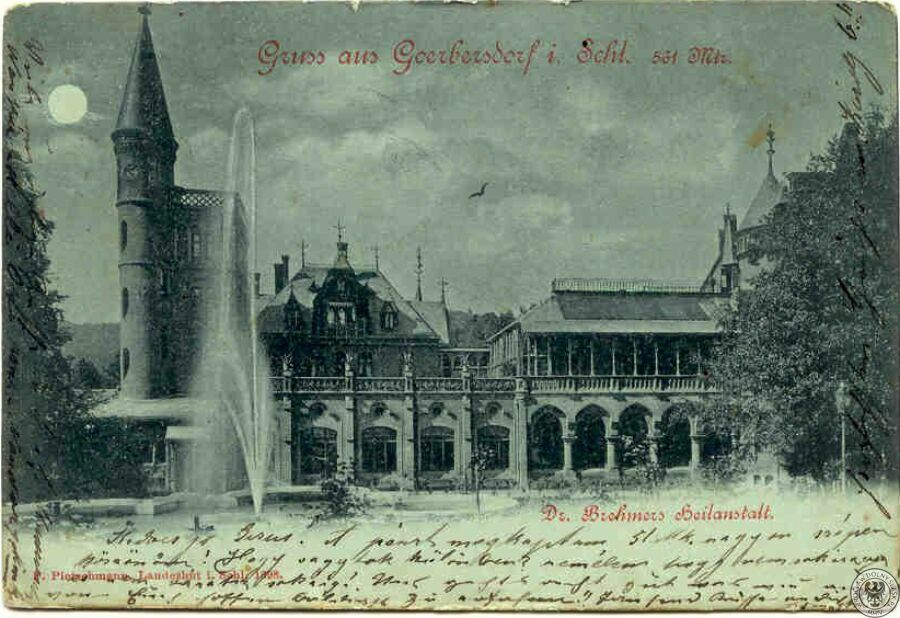
Shortly after obtaining the licence, Brehmer embarked on extensive construction work aimed at expanding Countess Colomb’s small hydrotherapy facility. In 1862, the first buildings were erected: the treatment centre, later known as the ‘old house’, and the guesthouses ‘Weisse Haus’ and ‘Villa Rosa’. At the same time, work continued. The buildings were designed by the renowned architect Edwin Oppler. The park, however, was the work of Brehmer himself.
In the mid-1870s, Dr Brehmer’s residence, a winter garden, a library and a slender tower were added to the old part of the sanatorium. In the late 1870s, the so-called ‘New Kurhaus’ was erected, adjoining the old one on the eastern side. All these buildings were constructed according to Oppler’s designs. In 1882, the interiors of the entire establishment were refurbished, with modernisation of the sanitary facilities, heating and air conditioning. For the guests of Dr Brehmer’s health resort, 303 rooms were provided, located in both kurhauses, in the villas belonging to the resort, as well as in guesthouses near the sanatorium that did not belong to the resort.
Shortly after its establishment, Brehmer’s sanatorium became extremely popular throughout Europe, as evidenced by numerous guidebooks on Görbersdorf, published not only in Germany but also in Budapest, Zurich, Paris, Vienna, Warsaw and St Petersburg. The greatest influx of guests occurred at the turn of the 19th and 20th centuries. In 1872, the establishment received 396 people, including 25 guests from Poland. In 1873, the figure was 706 people, including 110 from Poland.
The daily life of patients in Görbersdorf
According to Kiszczyński’s account from 1874, the start of the day at Brehmer’s establishment went as follows:
“For patients who were in better health, provided their condition allowed it, doctors usually recommended getting up around 6 o’clock in the morning, and at the sound of the trumpet everyone would gather at the Kurhaus for breakfast, which lasted from 7:00 to 8:00 in the morning; a second breakfast from 10.00 to 11.00; lunch from 13.00 to 14.00; afternoon tea from 4.00 pm to 5.00 pm; supper from 7.00 pm to 8.00 pm; the intervals between mealtimes, in accordance with the doctor’s instructions, are set aside for walks in the park or the hills, or for rest in one’s room. Those who do not report to the dining table at the appointed times, which are announced each time by a trumpet, will not be served a meal. For weaker patients, meals are brought to their rooms each time.”
“(…) A walk in the park, in the wooded hills, breathing in the refreshing air, taking in the picturesque landscape, or occasionally longer excursions in the surrounding area, these are the main, and at the same time therapeutic, forms of recreation; in addition, reading periodicals and books from the local library, playing chess, dominoes, draughts, the shooting range and concerts, which take place here every two weeks”.
New sanatoriums and the development of the village
Even before Brehmer’s death in 1889, two further sanatoriums were established in Görbersdorf. By the 1870s, the number of applicants had already exceeded the capacity of Dr Brehmer’s sanatorium. By the early 20th century, the village was equipped to accommodate around a thousand patients.
In 1872, Major Baron von Rössing built a Swiss-style villa above Brehmer’s sanatorium, which no longer exists today. It served the baron’s family, and some of the rooms were rented out to patients. Soon, the Major conceived the idea of establishing a second sanatorium. To this end, in the autumn of 1874, he made contact with Dr Theodor Römpler, who was then the court physician to the Prince of Solms-Baruth. A contract was drawn up under which Dr Römpler undertook to manage the new sanatorium for two years. Baron von Rössing then acquired extensive land stretching from his villa, on the terraces, towards the south-east, as well as a separate area at the foot of the so-called High Mountain. Soon, a restaurant building named ‘Bellevue’ was erected on the terrace. In the same year, the foundation stone was laid for the construction of the new establishment. In March 1875, Römpler took up his post, and in 1876 the sanatorium was completed. By the late 1870s, guests at Baron Rössing’s establishment had at their disposal: the baron’s own house, a restaurant, the sanatorium, rooms at the “Zur Preussische Krone” inn, and rooms rented in houses in the countryside. A building housing changing rooms and washrooms was erected near the facility.
On 1 June 1878, Römpler bought the entire establishment from Baron Rössing and soon set about creating a spa park. In 1883, a Swiss-style villa was built in the centre of the spa grounds, where the owner took up residence; it was named ‘Elsa’ after his wife.
In the same year, Römpler donated the land on the terrace above the Rössing villa for the construction of a Protestant church, the building of which, financed by contributions from the spa guests, began the following year.
In 1885, a winter garden was built next to the sanatorium; shortly afterwards (in 1901), an Orthodox chapel was built in the park for the large numbers of visitors arriving from Russia (Dr Römpler also donated the land for its construction). A year later, a large dining room was built between the sanatorium and the so-called ‘Turmvilla’ (the former ‘Bellevue’ restaurant). In 1887, a large, covered sunroom was erected. Towards the end of the 19th century, Dr Römpler realised his plan to create a promenade leading from the sanatorium to the ruins of Radosno Castle, which at the time ran along Górska Street. In 1898, a large ice house was built right next to the spa house, capable of holding 300 cubic metres of ice.
Towards the end of the 1880s, following Koch’s discovery of the tuberculosis bacillus, the number of patients fell significantly. However, the rise in the number of patients at the turn of the 20th century necessitated the modernisation and expansion of the facility, which included the outbuildings. In 1899, the facility was fitted with electric lighting. In its first 26 years of existence, the sanatorium admitted 5,800 patients. Treatment methods were modelled on those used by Brehmer; a library was established for the patients’ entertainment, and the sanatorium hosted theatrical performances, concerts and lectures.
The third major sanatorium – the ‘Mareinhaus’ sanatorium – was founded in 1894 by Countess Rückler and run by Dr Weichers. This sanatorium treated patients with mild tuberculosis and was situated in Görbersdorf and Schmidtsdorf (Kowalowa). In 1903, 1,125 patients were admitted. Furthermore, a number of smaller guesthouses and sanatoriums operated in Görbersdorf, such as Buchler’s sanatorium on Buchberg, founded in 1890 and expanded in 1928.
Culture and society in Görbersdorf
From the mid-19th century, Rudolf von Gottschall, a playwright and literary historian who was a friend of Maria von Colomb and Dr Brehmer, lived and worked in Görbersdorf. The beauty of Görbersdorf was celebrated in the poems of J.G. Urban, a self-taught poet born in 1818 in the Fuchsbinkel colony, who lived at the foot of Mount Buchberg. Albert Emil Brachvogel, a writer, playwright and book publisher born in Wrocław, also settled in Görbersdorf, before moving to Berlin after 1859.
Demographic and religious changes in Görbersdorf
In the early years of the 20th century, Görbersdorf was home to the inns ‘Zum Deulachen Kaiser’ and ‘Berghotel’, as well as the confectionery and café ‘Laugers Konditorei und Kaffe’. According to the “Gemeidelexikon” of 1898, the village had 832 permanent residents, including 618 Protestants, 188 Catholics and 25 Jews. The Protestant parish was located in Langwaltersdorf (Unisław Śląski), and the Catholic parish in Frydland (Mieroszów). Görbersdorf had 128 farms and a school. According to the census of 1 December 1905, the village covered an area of 331.3 hectares, comprising 72 residential buildings and 125 farm buildings. Görbersdorf had a population of 1,328, comprising 1,031 Protestants (of whom 1,023 were Germans), 267 Catholics (229 Germans and 14 Poles) and 29 Jews.
The development of winter sports in the 20th century
From 1888 onwards, holidaymakers from Scandinavia began to promote skiing in Görbersdorf; the sport was practised particularly actively in the 1930s, when a 50–60-metre (medium) ski jump [at the foot of the Kostrzyna slope, the landing area still visible today below the road] and a second, 30-metre (small) one.
Transformation after the First World War
After the First World War, as the importance of sanatoriums for tuberculosis began to decline and other resorts, such as Davos, began to gain renown, Görbersdorf transformed into a health resort and a winter sports centre. A cemetery was established in the village in the 1930s.
Changes after the Second World War and modern-day Sokołowsko
After the First World War, as the importance of sanatoriums for tuberculosis patients began to wane and other resorts, such as Davos, began to gain renown, Görbersdorf transformed into a health resort and a winter sports centre. A cemetery was established in the village in the 1930s. A new school was built in the centre of the town, and many houses were renovated and rebuilt. Despite this, the town has retained the character it acquired in the second half of the 19th century.
The modern history of the sanatorium in Sokołowsko is characterised by artistic activities and renovations carried out by the In Situ Foundation since 2007.